Nowruz (New Day) is the first day of Pamirian and Persian New Year, celebrated throughout the countries in most parts of Asia, which begins on the spring equinox marking the first day of the year, which several language groups celebrate. It is celebrated worldwide by various ethno-linguistic groups as New Year, and falls on or around March 21 of the Gregion calendar. It is the first day of Wakhi, Iranian and several ethno-linguistic calendar. In Wakhi it is called S̃heg̃hdsol (New Year). It is said that its origins go to the Zoroastrian but now it is considered a secular holiday for most celebrants and enjoyed by people of several countries and different faiths as well. The Muslims also celebrate it with evidences that Salman Farsi was celebrating this event by offering gift to Rasuli Pak (SW). In our part of the world from the ancient time the families had come together to observe the Shogũn (rituals) and is still continued. United Nations officially recognized the “International Day of Nowruz” with the adoption of UN resolution 64/253 in 2010.
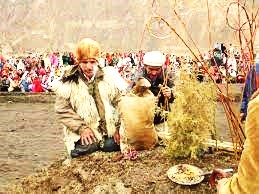
Among Wakhis in Gojal It is celebrated when nature equalizes day and night in the northern part of the globe. Early in the morning they go for prayers with special thanks to God for providing another opportunity to celebrate the event and inter to the New Year. In Shimshal a day before, some of the households offer an animal for Khedhoyi (niyaz/ sacrifice) or the community buy a bull or a yak to celebrate the event with khedhoyi (niyaz sacrifice). In the Nowroz day volunteers prepare khedhoyi while the gẽt̃ũw/subtribe invite each other stating from the house of the eldest person in the gẽt̃ũw (subtribe). If the families are more than three households they continue this invitation for two or three days. In the noon all the community members come together and enjoy a special food called bath with meat or beef prepared by the volunteers for khedhoyi/ niyaz.
Like other rechwals during the day of Nowroz three games Nis̃hona[i], Dẽrobi and T̃ẽksũri[ii] are played between two team from the community members. After khedhoyi youth arrange a game called Tẽksũri. This game starts from kitẽdhit and continues till tag̃hm, which children play every day in their leisure time. On the day of Nowroz and Ketẽdhit it is organized at community level. In the afternoon the young arrange a competition of Nis̃hona (targeting) for hunters along with Darobi another favorite game in Shimshla. Elders also participate in the competition. This was also a community based game to foster hunting, which was an occupation in the olden time. New hunters are also invited to participate and expose their hunting skills. Nowadays, this game is no more played, it was banned by the village organization due to arm restriction and cost effect. A nis̃hona (target) was placed at some distance and the participants were shooting on the black dot visible on nis̃hona (target). Children were organizing their own nis̃hona throwing stone on the target. So till tag̃hem children enjoy two games t̃ẽksũri and nis̃hona din. From Nowroz put din, thug̃hmay din and tẽpũk din are most favorite games of the girls.
The new married women take a molidaẽ tebaq (a pot of local food called molida) to their parents. The parents of the newly married women invite their relatives and offer molida fetched from amidhẽ[iii] khun (house of amidh). In return they (parents of the women) also send a potful molida and they also invite their relatives to eat the food brought from the amidhẽ khun. This happy and joyful day remains till the evening of the day
[i] Nishona is a game; shooting the target. People organize a target with black dot in the middle and hunter shoot the dot. Number of shots on the black dot makes a party wiener.
[ii] T̃ẽksũri is a game played between two parties. One party hit a tẽksũr (a pice of wood) with a stick called ghatenz̃ and another catch teksũr as fielder. If the fielders could not catch the tẽksũr they playing team count from the place of hitting to their where it falls otherwise if the teksũr is cached the hole playing team is terminated for fielding.
[iii] The families arranged marriage of their children, in relation they call amidh to each other.